
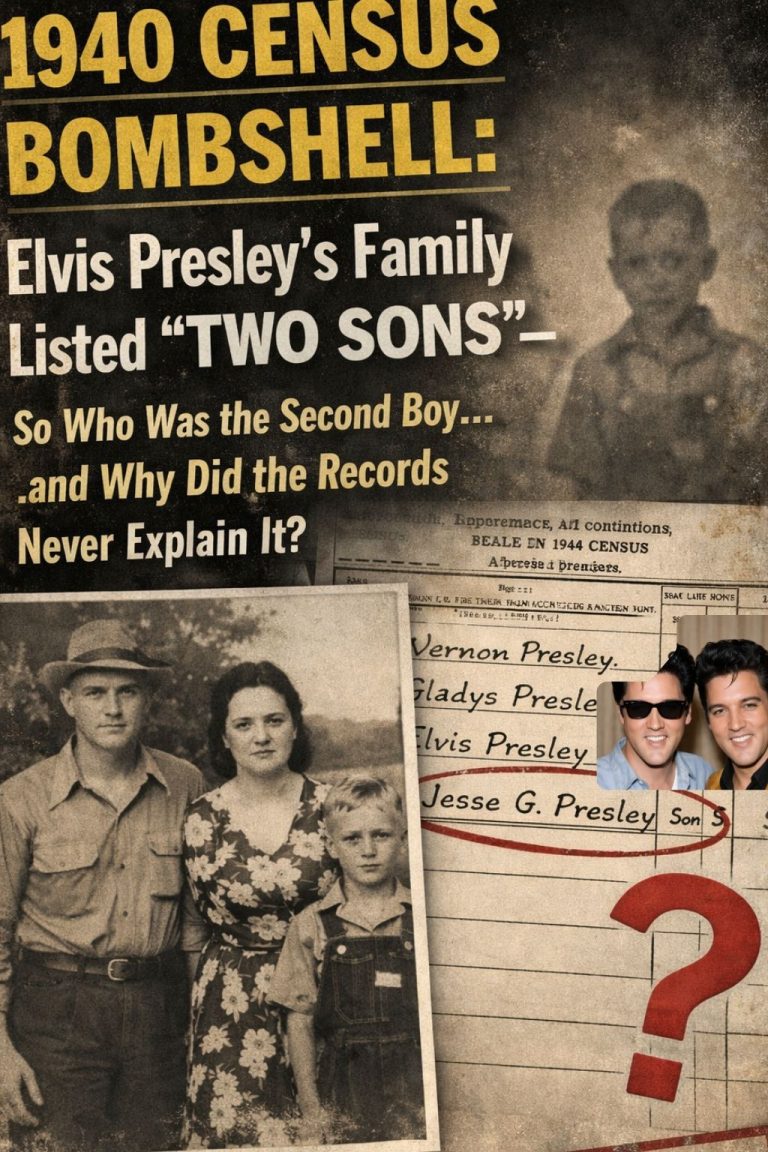
Few figures in American music history carry the enduring weight of Elvis Presley, a name that has long been associated with legend, transformation, and cultural identity. Generations have grown up believing they understood his beginnings — a modest upbringing, a singular path, a life that rose from simplicity into extraordinary fame. Yet, buried within the fragile pages of a 1940 census record, a quiet detail has resurfaced, one that invites a deeper, more reflective question: was the story ever as complete as it seemed?
Within that document, preserved through time yet rarely revisited with scrutiny, lies a line that appears almost ordinary at first glance. However, upon closer reading, it reveals something profoundly unexpected — the Presley household listed two sons. Not one, but two. Such a detail might seem minor in another context, but here, it introduces a layer of uncertainty that lingers heavily. History has only ever embraced one name, one life, one enduring legacy.
Careful observers have begun to revisit this record with a sense of quiet urgency. Was this a clerical oversight, a simple error made in a moment long forgotten? Or does it point toward something more delicate — a truth that, for reasons unknown, was never carried forward into public memory? The absence of clarification has only deepened the sense of mystery surrounding that single line.
Through decades of storytelling, biography, and remembrance, Elvis Presley's early life has been told with consistency. Each detail, each milestone, carefully preserved. Yet, this newly reconsidered fragment introduces a subtle fracture in that narrative. A second presence, recorded yet never acknowledged in the broader arc of history.
"💬 Perhaps some stories were never meant to be told in full… only remembered in fragments."
Such a thought lingers, not as an accusation, but as a reflection. Families, like history itself, sometimes carry moments that are quietly set aside — not erased, but left unspoken. The passage of time has a way of softening edges, of allowing certain truths to fade into the background while others are brought into the light.
Those who study historical records understand that documents, while factual in nature, are not always complete in meaning. They capture moments, not explanations. They preserve names, but not always the stories behind them. In this case, the presence of two sons raises a question that no surviving document has fully answered.
Consider the emotional weight such a possibility might carry. A life that existed, even briefly, yet never became part of the narrative the world came to know. A name that may have been spoken within the walls of a home, but never echoed beyond it. These are not conclusions, but reflections — possibilities that arise from a single, unresolved detail.
Interest in this record has grown quietly, not through sensational claims, but through thoughtful reconsideration. Historians, enthusiasts, and longtime admirers have found themselves drawn not to definitive answers, but to the silence itself. Silence, in this case, speaks with a certain gravity.
No additional records have surfaced to confirm or deny what that census entry suggests. No clear explanation has emerged to resolve the discrepancy. Instead, what remains is a lingering sense of incompleteness — a feeling that something, however small or fleeting, may have slipped beyond the edges of recorded history.
Time has a way of preserving what it chooses, yet it also leaves behind spaces that invite interpretation. In those spaces, questions endure. Not all are meant to be answered, and perhaps that is part of their lasting power.
A single line in an old document.
A detail that refuses to settle into certainty.
A story that feels both familiar and quietly unfinished.
Whether it represents an error, a forgotten moment, or something more deeply personal, the truth remains just out of reach. What is certain, however, is that this small fragment has reopened a conversation — one that does not seek to redefine a legacy, but to gently question the edges of what has long been accepted.
Somewhere between what was written and what was remembered, a gap remains.
One name became immortal.
One line remained unexplained.
And the silence between them continues to echo.