
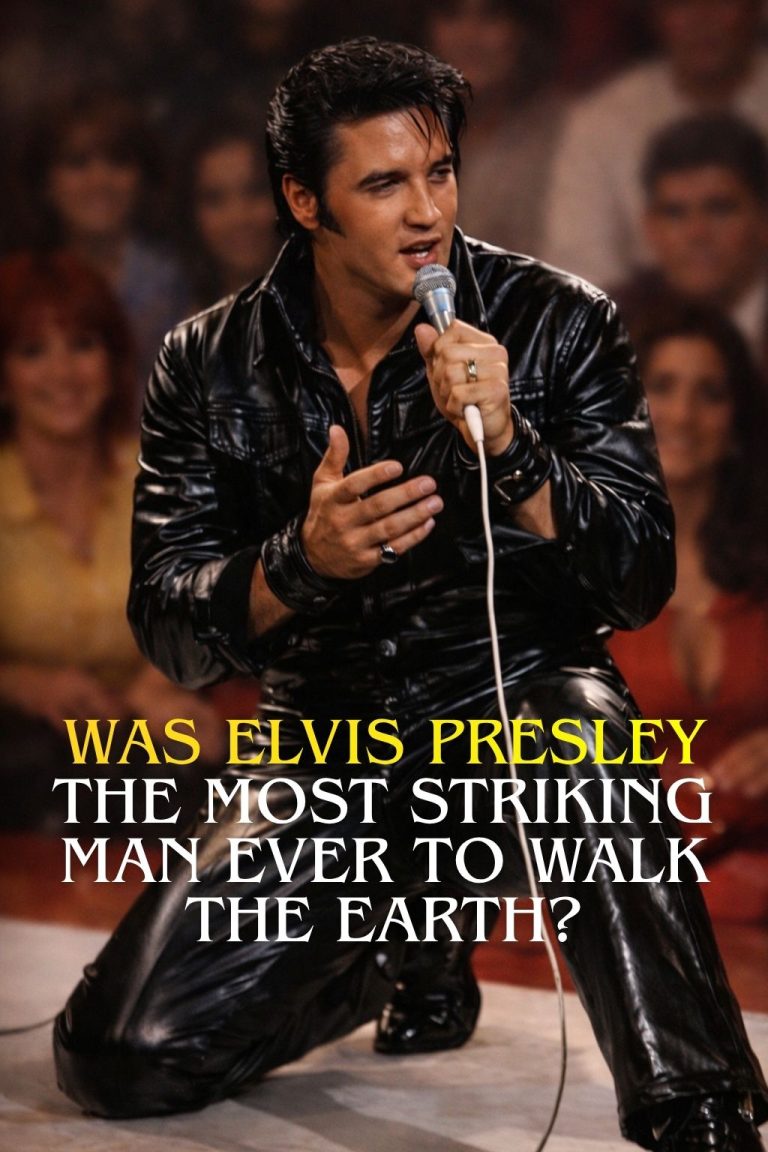
In 1969, something extraordinary unfolded that still echoes through history. Elvis Presley, already crowned the King of Rock and Roll, stepped back into the spotlight with a presence that felt almost unreal. Audiences did not simply watch him—they experienced him. Every movement, every glance, every note carried a sense of renewal and quiet power that few performers have ever achieved. This was not merely a comeback; it was a moment of transformation that redefined what it meant to command a stage.
Following the success of the 1968 television special, he returned with a confidence that felt both commanding and deeply human. Dressed in striking black leather, he stood beneath the lights with a gaze that seemed to reach beyond the crowd. Yet what truly lingered in people's memories was not just the image, but the feeling he created the instant he appeared. Witnesses often struggled to put it into words, describing an energy that shifted the atmosphere in the room the moment he walked in.
Many who encountered him up close spoke not only of his appearance but of his gentle nature and attentiveness. Conversations with him felt personal, never rushed, never distant. He had a way of listening that made others feel seen and valued. That rare combination—global fame paired with genuine humility—left a lasting impression far beyond the stage. Behind the legend stood a man shaped by modest beginnings in Tupelo, Mississippi, where faith, respect, and kindness formed the foundation of his character.
Onstage, however, a different dimension emerged. Elvis possessed a magnetic authority that drew every eye toward him, yet there were fleeting moments when his expression softened, revealing a warmth that felt almost disarming. His smile could quiet an arena, and his laughter carried a sincerity that reminded audiences they were not witnessing a distant icon, but a real person sharing something deeply personal. Each performance felt less like a spectacle and more like a conversation between artist and audience, filled with emotion that could not be rehearsed or replicated.
Debates about his legacy have continued across generations, often growing more intense with time. Admirers of other rock legends frequently challenge his place at the very top, pointing to the evolution of music and the emergence of new icons. Yet supporters of Elvis remain unwavering in their conviction.
💬 "No one else had that presence," one devoted fan insists. "He didn't just sing—he made you feel something you couldn't explain."
💬 "Legends came after him and changed the sound," another voice counters, "but influence alone doesn't make someone unmatched."
💬 "Influence, presence, humanity—he had all three," an Elvis admirer replies firmly. "That combination has never been repeated."
Such exchanges continue, reflecting a question that refuses to fade. Was it his voice, his charisma, or something far more intangible that set him apart? Perhaps the answer lies in the way people still respond to recordings and images from that remarkable year. Decades have passed, yet those moments remain vivid, almost untouched by time.
Elvis Presley's legacy cannot be reduced to appearance or performance alone. It lives in the emotional connection he created, the sense that each listener mattered, and the belief that music could bridge distances between strangers. His influence shaped not only a genre but an entire cultural landscape, leaving behind a standard that continues to challenge every generation that follows.
Still, the debate refuses to settle. Some will always argue that others surpassed him in innovation or technical skill. Others will stand firmly by the conviction that what Elvis possessed went beyond measurable qualities. And perhaps that is where the truth remains—somewhere between admiration and mystery, never fully resolved.
One fact remains undeniable: Elvis Presley did not simply perform—he left an imprint that refuses to fade. Whether seen as the greatest or simply one of the most unforgettable, his presence continues to stir emotion, spark discussion, and inspire reflection.
And the question lingers, growing louder with time—was he truly the most captivating figure to ever grace the stage, or has the world simply never found another who could make it feel that way?